Basement Waterproofing in Scarborough: Bluffs, Ravines & What Homeowners Need to Know
Scarborough's dramatic Bluffs, extensive ravine networks, and diverse housing stock make basement waterproofing here unlike anywhere else in the GTA. This comprehensive guide covers everything Scarborough homeowners need to know — from Bluffs erosion and Highland Creek flooding to TRCA permit requirements, neighborhood-by-neighborhood challenges, and 2026 pricing.
.webp)
Why Scarborough Is Different: Bluffs, Ravines & Glacial Clay
Basement waterproofing in Scarborough isn't a one-size-fits-all job. The area's unique geology — the dramatic Scarborough Bluffs, one of Toronto's most extensive ravine networks, and glacial clay deposits that shift with seasonal moisture — creates waterproofing challenges you won't find anywhere else in the GTA.
The Scarborough Bluffs Factor
The Scarborough Bluffs stretch 15 kilometres along Lake Ontario, rising up to 65 meters above the waterline. These glacial formations are made of layered sand, clay, and till deposited during the last Ice Age — and they're actively eroding. Properties within 500 meters of the bluff edge experience elevated groundwater pressure as lake water percolates through these porous layers, pushing against basement foundations from below.
Three Geological Factors That Make Scarborough Basements Vulnerable
Glacial Bluff Clay
Scarborough's glacial clay expands when wet and shrinks when dry, creating a cyclical pressure against foundations. During spring thaw and heavy rain, this clay can exert over 500 pounds per square foot of lateral pressure on basement walls — enough to crack poured concrete and collapse cinder block.
Variable Water Table
Unlike areas with predictable water tables, Scarborough's groundwater levels fluctuate dramatically based on proximity to the Bluffs, ravine systems, and season. A basement that's bone-dry in August can have water seeping through the floor in April. This variability requires drainage systems designed for peak conditions.
Ravine Drainage Patterns
Scarborough's ravine network — Highland Creek, Rouge River, and dozens of tributaries — collects and channels water across the landscape. Properties near ravine crests experience lateral water movement through soil layers, while valley-bottom homes face direct flooding risk during heavy rainfall events.
These factors combine to make Scarborough one of the highest-risk areas for basement water damage in the entire GTA. The 2013 Toronto flood event — which dumped 126mm of rain in two hours — caused an estimated $65 million in residential damage across Scarborough alone, much of it from basement flooding in the Highland Creek and Rouge River corridors.
Related Images & Examples
.webp)
Full exterior excavation and waterproofing
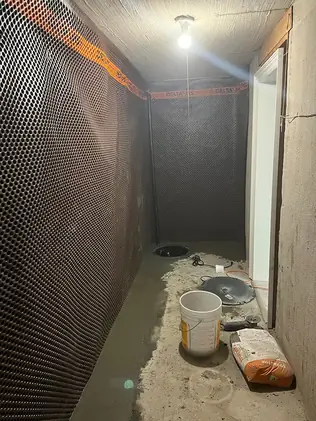
Interior drainage system installation
Professional installation with warranty
Highland Creek & Rouge River: Scarborough's Flood Corridors
Two major waterways define Scarborough's flooding landscape: Highland Creek running through the centre and the Rouge River along the eastern boundary. Understanding their behaviour is essential for any Scarborough homeowner considering basement waterproofing.
Highland Creek
Highland Creek and its tributaries drain a 102 km² watershed covering most of central Scarborough. The creek runs through West Hill, Highland Creek village, and Morningside before emptying into Lake Ontario at Colonel Danforth Park.
- Peak flood risk: March-May (spring thaw) and July-September (summer storms)
- Most affected areas: Morningside, West Hill, Highland Creek village, Ellesmere-Military Trail corridor
- 2013 flood impact: Over 1,200 basements flooded in the Highland Creek corridor
- Key streets: Military Trail, Old Kingston Rd, Ellesmere Rd, Morningside Ave
Rouge River
The Rouge River forms Scarborough's eastern boundary, with its watershed extending into Markham and Pickering. The Rouge National Urban Park preserves much of the floodplain, but residential areas along its edges face significant flood risk.
- Peak flood risk: Spring thaw runoff and intense summer rainfall events
- Most affected areas: Rouge, Rouge Hills, Port Union, Centennial
- Unique challenge: Rouge River's wide floodplain means groundwater elevation affects homes hundreds of meters from the river bank
- Key streets: Sheppard Ave E, Meadowvale Rd, Rouge Hills Dr, Port Union Rd
What This Means for Your Basement
If your Scarborough home is within 200 meters of Highland Creek, the Rouge River, or any of their tributaries, standard waterproofing may not be sufficient. Creek-adjacent properties need high-capacity sump pump systems (dual pump with battery backup), backwater valves on all floor drains, and exterior grading that directs surface water away from the foundation. During the 2013 flood, homes with these systems experienced 80% less damage than those without.
TRCA Permit Requirements for Scarborough Waterproofing
Many Scarborough properties fall within areas regulated by the Toronto and Region Conservation Authority (TRCA). Understanding when you need a permit — and when you don't — can save weeks of delays and thousands in fines.
When You DON'T Need a TRCA Permit
- ✓ Interior waterproofing (no exterior excavation)
- ✓ Sump pump installation (interior work only)
- ✓ Backwater valve installation on existing plumbing
- ✓ Interior crack injection
- ✓ Properties outside TRCA regulated areas
When You DO Need a TRCA Permit
- ✗ Exterior excavation within 30m of a ravine crest
- ✗ Any work within a TRCA-mapped floodplain
- ✗ Grading changes that alter drainage patterns
- ✗ New discharge points for sump pump drainage
- ✗ Any work on slopes steeper than 3:1
TRCA Permit Timeline & Costs
Application Fee
$350-$750 depending on scope
Processing Time
4-8 weeks for standard applications
DrySpace Handles It
We prepare and submit all TRCA applications at no extra charge
Pro tip: If you're unsure whether your Scarborough property is in a TRCA regulated area, check the TRCA regulation mapping tool or contact us for a free assessment — we'll identify any regulatory requirements during your inspection.
Scarborough Neighborhood-by-Neighborhood Waterproofing Challenges
Each Scarborough neighborhood has distinct waterproofing challenges based on geology, housing stock, and proximity to water features. Here's what we see most often in each area.
Agincourt (85 projects completed)
Typical homes: 1960s-70s bungalows and split-levels along Finch Ave E, Sheppard Ave E, Birchmount Rd, and McCowan Rd corridors.
Common issues: Original cinder block foundations with failed waterproofing, collapsed weeping tile systems clogged with 50+ years of clay sediment, and horizontal cracks from decades of freeze-thaw cycles. Many Agincourt basements have been partially finished over existing water problems, hiding damage until mold becomes visible. Interior drainage with new weeping tile is the most common solution — typically $14,000-$20,000.
Birch Cliff & Cliffside (79 projects combined)
Typical homes: Mix of 1940s-60s homes near the Bluffs along Kingston Rd, Birchmount Rd, and Midland Ave.
Common issues: These are Scarborough's most complex waterproofing projects. Bluffs-edge properties deal with lateral groundwater movement through glacial clay, slope instability that shifts foundations, and lake-effect moisture. Many homes sit on steep grades requiring custom drainage designs. Exterior waterproofing with slope stabilization is often necessary — budget $20,000-$35,000 for comprehensive protection.
Guildwood (48 projects completed)
Typical homes: 1950s-70s homes in the Guildwood Parkway/Living Arts Dr area, many backing onto ravines.
Common issues: Ravine-adjacent properties face seasonal water table fluctuations and lateral soil moisture. The Guild Inn area's steep terrain channels surface water toward lower-elevation homes. TRCA regulations apply to many Guildwood properties, requiring permit coordination for exterior work. Interior systems are effective for most — $12,000-$18,000 typical.
Highland Creek & Morningside (99 projects combined)
Typical homes: 1970s-90s suburban homes along Military Trail, Ellesmere Rd, and Morningside Ave.
Common issues: Highland Creek flooding is the primary concern. Homes within the creek's floodplain experienced devastating water damage in 2013. Even properties on higher ground face elevated groundwater during spring thaw as the creek system backs up. High-capacity dual sump pump systems with battery backup are essential — along with backwater valves on all floor drains.
Malvern (62 projects completed)
Typical homes: 1970s-80s subdivisions along Neilson Rd, Morningside Ave, and Finch Ave E.
Common issues: Many Malvern subdivisions were built on former farmland with clay soils and inadequate municipal drainage infrastructure. The 30-40 year mark is when builder-installed weeping tiles typically fail. Common symptoms include cove joint leaks, floor cracks, and damp spots on walls after rain. Standard interior drainage — $12,000-$18,000.
Rouge & Rouge Hills (55 projects completed)
Typical homes: Mix of 1960s-90s homes along Sheppard Ave E, Meadowvale Rd, and Rouge Hills Dr.
Common issues: Rouge River proximity creates seasonal groundwater elevation changes that push water through basement floors. The Rouge National Urban Park boundary means some properties adjoin undeveloped floodplain. Newer Rouge subdivision homes (1990s+) often have builder-grade waterproofing that's now reaching end of life. Comprehensive interior drainage with enhanced sump capacity — $14,000-$22,000.
West Hill (47 projects completed)
Typical homes: Older 1950s-70s housing along Kingston Rd, Lawrence Ave E, and Morningside Ave.
Common issues: West Hill sits in the Highland Creek valley, making it one of Scarborough's highest flood-risk areas. Older homes have original drainage systems well past their service life. Many properties have been modified over decades with additions and grade changes that worsen drainage. Full interior drainage replacement with high-capacity pump — $15,000-$22,000.
Scarborough Homes by Construction Era: What to Expect
Scarborough's housing stock spans from the post-war building boom to modern subdivisions. Each era used different foundation types, drainage methods, and waterproofing materials — and each has predictable failure patterns.
1950s-1960s: Post-War Bungalows
AGINCOURT, WEST HILL, CLIFFSIDE, WEXFORD
Foundation Type
Poured concrete or cinder block, shallow footings (often only 3-4 feet below grade). Many lack any waterproofing membrane — just a tar coating that failed decades ago.
Common Problems
Original clay weeping tiles collapsed or clogged. Cinder block walls develop horizontal cracks from 60+ years of frost heave. Efflorescence (white mineral deposits) on basement walls indicates chronic moisture migration.
Recommended approach: Full interior drainage system with new 4" perforated PVC weeping tile, sump pump with battery backup, and crack injection. Budget: $14,000-$22,000.
1970s-1980s: Split-Levels & Raised Ranches
MALVERN, ROUGE, HIGHLAND CREEK, MORNINGSIDE
Foundation Type
Poured concrete walls, deeper footings. Split-level design means multiple floor elevations with complex drainage requirements. Most had parging (thin cement coating) instead of true waterproofing.
Common Problems
Parging failure exposes concrete to moisture absorption. Window wells flood during storms. The split-level cove joint (where floor meets wall) is a primary leak point. Slab-on-grade sections at the upper level often have no drainage.
Recommended approach: Targeted interior drainage at cove joints, window well drainage systems, and exterior parging repair with rubberized membrane. Budget: $12,000-$20,000.
1990s-2000s: Subdivisions & Townhomes
ROUGE, MALVERN NORTH, CENTENNIAL, MORNINGSIDE
Foundation Type
Poured concrete, builder-grade damp proofing (not true waterproofing). Modern building code but often built on former agricultural land with challenging clay soils.
Common Problems
Builder-applied damp proofing is failing at the 20-25 year mark. Lot grading has settled over time, now directing surface water toward foundations. Shared drainage in townhome complexes creates liability gaps between units.
Recommended approach: Exterior waterproofing membrane replacement with proper drainage board, re-grading, and individual sump pump systems for townhome units. Budget: $15,000-$28,000.
2026 Basement Waterproofing Costs in Scarborough
Waterproofing costs in Scarborough vary based on the method used, basement size, foundation condition, and proximity to the Bluffs or ravines. Here are current 2026 price ranges from actual Scarborough projects.
Interior Waterproofing — Most Common for Scarborough
| Component | Per Linear Foot | Typical Total |
|---|---|---|
| Interior drainage system | $150-$275 | $8,000-$18,000 |
| Sump pump + battery backup | — | $2,500-$5,000 |
| Crack injection (per crack) | — | $350-$800 |
| Backwater valve | — | $1,800-$3,500 |
| Average Scarborough Project | — | $12,000-$25,000 |
Exterior Waterproofing — For Severe Cases & Bluffs Properties
| Component | Per Linear Foot | Typical Total |
|---|---|---|
| Excavation to footing | $40-$65 | $4,000-$9,000 |
| Waterproof membrane | $30-$50 | $3,000-$6,500 |
| New weeping tile + gravel | $50-$85 | $5,000-$10,000 |
| Backfill + grading | $25-$40 | $2,500-$5,500 |
| Bluffs-Area Premium | +15-20% | $20,000-$40,000 |
Scarborough Rebates Can Save You $3,400
As a Toronto resident, you qualify for the City of Toronto Basement Flooding Protection Subsidy: up to $1,250 for backwater valve installation, $1,750 for sump pump installation, and $400 for pipe severance/capping. DrySpace handles the entire application process — we've helped over 200 Scarborough homeowners claim this rebate.
When to Waterproof Your Scarborough Basement
Not sure if your Scarborough basement needs waterproofing? Here are the warning signs specific to our area — and the best timing for the work.
Warning Signs Every Scarborough Homeowner Should Watch For
Act Now — These Are Urgent
- ⚠ Standing water on basement floor after rain
- ⚠ Visible water streaming down walls during storms
- ⚠ Horizontal cracks in foundation walls (structural risk)
- ⚠ Sump pump running constantly or not keeping up
- ⚠ Musty/mold smell that doesn't go away with ventilation
Plan Ahead — These Will Get Worse
- ⚠ White powder (efflorescence) on basement walls
- ⚠ Damp spots that appear after rain then dry out
- ⚠ Hairline cracks in foundation walls or floor
- ⚠ Paint peeling or bubbling on basement walls
- ⚠ Humidity above 60% in basement despite dehumidifier
Best Season for Scarborough Waterproofing
| Season | Interior Work | Exterior Work | Cost Factor |
|---|---|---|---|
| Spring (Mar-May) | Excellent | Limited (wet soil) | Peak demand — book early |
| Summer (Jun-Aug) | Excellent | Ideal | Standard pricing |
| Fall (Sep-Nov) | Excellent | Good (until freeze) | 5-10% discounts available |
| Winter (Dec-Feb) | Excellent | Not recommended | Shortest wait times |
Scarborough Basement Waterproofing: Frequently Asked Questions
Interior waterproofing: $150-$275 per linear foot ($12,000-$25,000 average project). Exterior: $200-$350 per linear foot. Bluffs-area properties run 15-20% higher. Most Scarborough homeowners spend $15,000-$20,000 for a comprehensive interior system with sump pump and backwater valve. Toronto's Basement Flooding Protection Subsidy can reduce costs by up to $3,400.
Interior waterproofing does not require a TRCA permit. Exterior excavation within 30 meters of a ravine crest or within a TRCA-mapped floodplain does require approval. Processing takes 4-8 weeks and costs $350-$750. DrySpace handles all TRCA permit applications at no extra charge.
Yes — all Scarborough residential properties qualify. The subsidy covers up to $1,250 for backwater valve installation, $1,750 for sump pump installation, and $400 for pipe severance/capping. DrySpace handles the application and ensures your installation meets all program requirements for full reimbursement.
The Bluffs' glacial clay erodes from wave action and groundwater seepage, creating elevated hydrostatic pressure against nearby foundations. Properties within 500m of the bluff edge face unstable soil, seasonal clay movement, and variable water tables. Waterproofing here requires reinforced drainage, slope-specific membrane systems, and often exterior work — expect 15-20% higher costs than standard Scarborough projects.
Interior waterproofing can be done year-round. Exterior work is best May through October when the ground is workable. Booking in fall or winter typically means shorter wait times and 5-10% seasonal discounts. The worst time to discover you need waterproofing is during spring thaw — proactive assessment in fall saves emergency costs.